
GST on scrap trips up more B2B businesses than almost any other part of the transaction. The rate itself is simple enough once you know it, but the real confusion lies in the invoice: which HSN code to use, whether reverse charge applies, and what a registered buyer will ask to see before releasing payment. Get it wrong, and a routine scrap deal turns into a notice months later.
At MetalMandi, we are a digital scrap marketplace, powered by Attero Recycling. We work directly with businesses across India, so there is no broker, trader, or middleman standing between the factory floor and a fair price. Every quote you see on our app comes from live market data, tracked in real time, and every payment moves fast once the material is verified.
MetalMandi currently works with 550+ vendors, from small kabadiwalas (scrap dealers) clearing a single godown to large manufacturers running monthly stock, and price negotiation is always on the table wherever it applies.
This guide breaks down GST on scrap step by step, from rates and HSN codes to the reverse charge rules that came into effect in October 2024.
What Is a GST Invoice and Why B2B Scrap Deals Need One
A GST invoice is a document that records a taxable transaction, showing the value of goods, the applicable tax rate, and the GST registration details of both parties. For B2B scrap transactions, this invoice allows the buyer to claim Input Tax Credit (ITC) and keeps the deal traceable to tax authorities.
Without one, a scrap transaction is difficult to defend during a GST audit, and the buyer cannot offset the tax paid against their own liability.
GST Rates on Scrap by Material Type
Metal scrap in India is taxed under a handful of HSN chapters, and almost all of it falls in the standard slab. Iron and steel scrap falls under HSN Code 7204 and is taxed at 18% GST. This rate generally applies to scrap generated from manufacturing waste, dismantled structures, old machinery parts, and vehicle scrap.
GST Rate on Iron Scrap
The GST rate on iron scrap is 18%, whether the scrap comes from a demolished structure, a scrapped machine, or manufacturing rejects. This is one of the more stable rates in the scrap economy and has not moved much in recent years.
GST Rate on Metal Scrap
Across most non-ferrous categories, the GST rate on metal scrap is also 18%. Copper and brass scrap are grouped in the non-ferrous metal chapters, under headings for waste and scrap of those metals, and aluminium follows the same pattern.
GST Rate on Copper Scrap
Copper scrap GST is also charged at 18%, under its own HSN heading. There is no separate concessional rate for copper, brass, or aluminium scrap; the 18% slab rate applies to the entire non-ferrous metal scrap category.
HSN Codes for Scrap Categories
Getting the HSN code of iron scrap right on an invoice matters as much as the tax rate itself, since a wrong code can trigger a mismatch during return filing.
The HSN code for steel scrap is 7204, used for ferrous waste and scrap of all grades. Copper waste and scrap are classified under HSN Code 7404, which covers copper wire scrap, copper pipe scrap, and copper sheet scrap, while aluminium scrap sits under HSN 7602. Brass, being a copper alloy, is also billed under the copper heading.
Step-by-Step: How to Generate a GST Invoice for a Scrap Transaction
- Confirm the GST registration status of both parties.
- Identify the correct HSN code for the material.
- Apply the 18% rate to the taxable value.
- Record weight, grade, and rate per kg on the invoice.
- Note whether reverse charge applies.
- Issue the invoice with a unique reference number if required.
Details Required on the Invoice
A valid invoice needs the GSTINs of both parties, the invoice number and date, the HSN code, the description of the material, the quantity, the taxable value, and the GST amount split as CGST/SGST or IGST. Missing even one field can hold up ITC claims for the buyer.
Reverse Charge Mechanism (RCM) for Scrap Businesses
This is where most confusion happens. Notification No. 06/2024-Central Tax (Rate), effective from 10 October 2024, brought metal scrap under reverse charge when supplied by an unregistered business to a registered one.
In that case, the registered buyer is liable to pay GST under RCM and can later claim it as input tax credit. If both parties are registered, the normal forward charge rules apply, and a 2% TDS is deducted on B2B transactions exceeding ₹2.5 lakh.
Invoicing Checklist: Make the Right Decisions
- Confirm whether the counterparty is registered or unregistered.
- Use the correct HSN code for the material grade.
- Apply 18% GST unless a specific notification says otherwise.
- Check if RCM or TDS applies before finalising the invoice value.
- Keep a copy of the e-way bill for bulk loads.
Documents B2B Buyers Usually Ask For
Most registered buyers will ask for a GST invoice, a copy of your GST registration certificate, a weighment slip, and sometimes a delivery challan or e-way bill for larger loads. Having these ready in advance speeds up payment and avoids back-and-forth.
How MetalMandi Helps With GST-Compliant Scrap Transactions
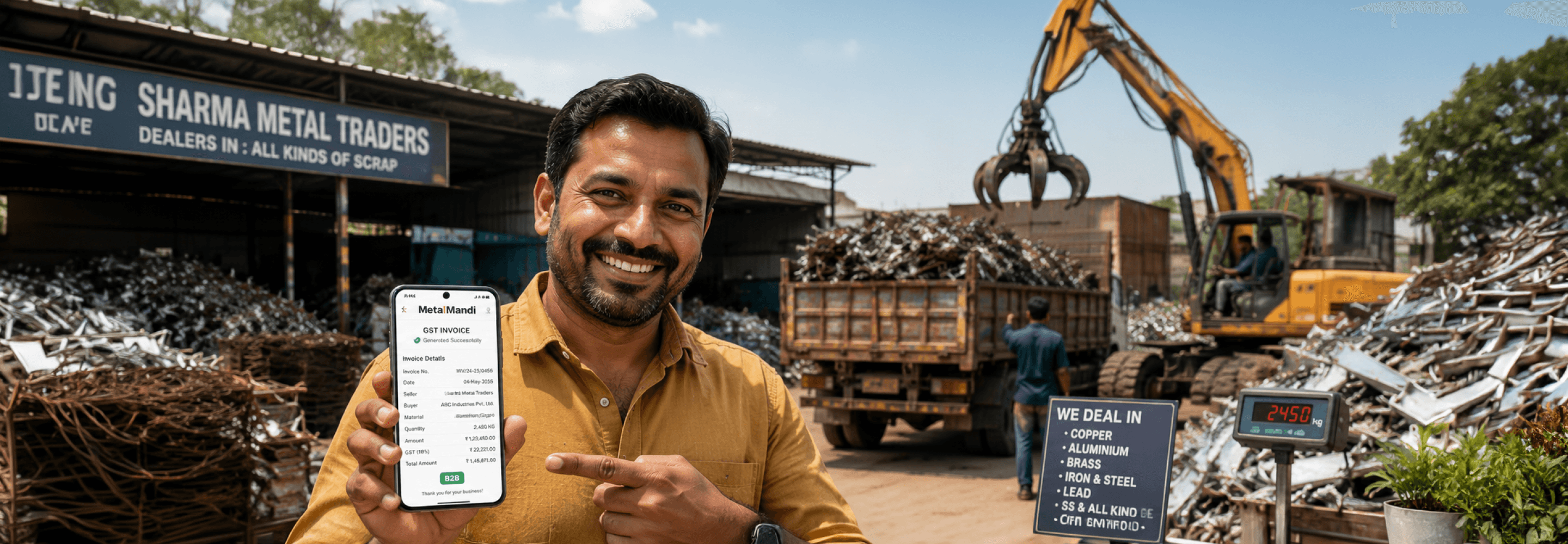
Every transaction on the MetalMandi app is recorded digitally, with rates, weight, and material grade logged against a verified invoice.
Because MetalMandi is the direct buyer, businesses do not need to chase multiple parties for paperwork. Everything sits in one place, on one app, backed by Attero Recycling.
GST on scrap is not as complicated once the HSN codes and reverse charge rules are clear. Getting the invoice right the first time saves both parties from notices and delays later.
FAQs
What is the current GST rate on scrap in India?
Most metal scrap, including iron, steel, copper, aluminium, and brass, is taxed at 18% GST under its respective HSN chapters, with reverse charge applying in specific unregistered-to-registered transactions.
What HSN code should I use for iron or steel scrap?
Iron and steel scrap is classified under HSN Code 7204, covering ferrous waste and scrap generated from demolition, manufacturing, or old machinery.
How does the reverse charge mechanism apply to scrap sales?
Under RCM, effective 10 October 2024, a registered buyer pays GST when purchasing scrap from an unregistered business, rather than the business charging it upfront.
What details must a GST invoice for scrap include?
It needs the GSTIN of both parties, invoice number, date, HSN code, material description, quantity, taxable value, and the GST split as CGST/SGST or IGST.
Is GST different for copper scrap compared to iron scrap?
No. Both copper scrap and iron scrap are taxed at 18% GST, though they fall under different HSN codes: 7404 for copper scrap and 7204 for iron and steel scrap.